Wow I can't believe I actually made these. This utterly charming pattern is by Misusu, a lovely and generous person whose work typically focuses on the youngest amongst us, but who has also recently made available a very interesting blouse pattern (more on that below).
This downloadable pattern comes with several sizes already pre-drawn, which will allow your crafting prowess to keep up with the growing infant. Using some cotton remnants, I made the size 10 (10 cm long sole), which is about 3 months size. The instructions that come with the pattern are great - the only change I made is to attach the back tab to the outer part of the bootie before sewing the inner and outer ones together. This makes it easier to turn and sew that last seam line smoothly.
Now, about the blouse? Audrey had made it recently, and it was her discussion and very pretty result that led me to its pattern, which in turn led me to the booties. The blouse looks like something I'd love to make; even more, I love the opportunity to draft the pattern from scratch based on the dimensions Misusu gives, again, in downloadable form. What a great idea! it saves printing all these pages to tape together, and makes us stretch our abilities just a tad.
Thank you, Misusu, for your very real contributions to our sewing.
Yessss!!! Laugh at me, do. Of course I'll not be the one to give birth. I'll be the wicked step-grandmother; I've been practicing for the role for well over half of my SD's lives, as their wicked stepmom. So I'll be a very good evil (ok, maybe not totally evil), wicked old granny, mwahahahah! I'm already dusting off my copy of the Brothers Grimm, as a refresher of the frightening magic and very pc-uncorrect tricks that ugly old hags are expected to perform on all the yummy, delicious, trusting, naive youth who happen to stumble into their clutches. The best and most complete version is "Household Tales of the Brothers Grimm", which has all 200 tales and 10 legends. You can read these delightfully wicked little pieces online. Trust me, there's not a whiff of boring old saccharine Disney in any of them! And when you finish the Grimm offering, you can move on to peruse the remaining 45,999 books at the Gutenberg Project, (https://www.gutenberg.org/). If you could read just one book per day, it'll take you only 126 years to get through the entire collection. But that's only if you're able to read in every language on offer; if you're limited, like most of us, to only three or four languages, you may be able to whittle the time to oh, maybe just a little over 100 years.
The other great thing about the Gutenberg Project? it has a small collection of sheet music. Once you've browsed through that, move on to the Petrucci Music Library: 300,000 scores! Now that's just the thing to soothe the savage beast after the all wickedness awoken by those German fairy tales.
I'm feeling very sentimental about this little impending arrival. My youngest is the last of a large gaggle of kids and cousins of his generation, a Benjamin of our extended family in the truest sense of the Old Testament allusion. It seems in no time flat he's gone from a squiggly little moppet to an independent young man who turns wheelies on snowpack and likes to discuss physics - today, heat transfer equations - with his mother (I kid you not). What's 16 years? An eyeblink. The Voyager spacecraft - both of them - have been out there, telling us ever more about the outer solar system and beyond, for nearly 40 years. And they're still talking. The New Horizons spaceship has been flying towards Pluto for 9 years, just so it can take better pictures of it, our last, littlest, demoted to dwarf status itty bitty planet, than can the Hubble with its ultra expensive corrective specs. After 9 years, it's almost there: what's 200 million kilometers between friends?! Poor little Pluto will reveal its pouting face to the cameras in July, right around the same time that the new little one we're anticipating will face the lens and flash of our own.
Being a practical sort of wicked grandma to be, I already made the little tyke a blankie. Well, actually, I made two. I like making these for the new arrivals - and have been ever since my own kids became more than just a twinkle in their father's eyes. I'm persuaded that this is a form of practice towards a quilt that keeps hinting at its existence somewhere in my retirement (if I ever get there...).
Here are two of my youngsters with one of the smaller blankets I made. The blanket reflects my love of things tartan, being a Nova Scotia tartan in cotton flannel, and my other love of strong contrasts, here the surprising association of blue and red - hence the red poly fleece. I bound it in shiny satin ribbon to offer some tactile and visual stimulation to my tiny boy.
Did you know that Canada and each of its provinces and territories has a tartan pattern? It's the heritage of our early Scottish immigration! I made several tartan-inspired blankets and sheets for him around that time. The largest of the lot, at 1 x 1.5m, in a nice New Brunswick tartan, remains the topper on his bed to this day.
I went with conventional baby-themed colours this time, because that's what was available - I don't stash baby stuff supplies. Both blankets are a sandwich of soft poly fleece on one side and a cotton or cotton blend flannel on the other, prewashed/predried in hot water/hot dryer before assembly. I decided not to bind the blankets, but sewed the layers together right sides together, flipped them out through a small opening, and then topstitched around the edge with a small, tight zigzag to flatten it, favouring the stretchier fleece a little towards the cotton side.
The smaller blanket is a meter square, with one corner cut away and used to create a hood at the opposite end. For a very little tyke, that makes for a nice warm swaddling configuration, with the infant's head under the little hoodie:
But, you know, they don't stay swaddled for long! Within a year or so, they begin to run around and make us believe they're Superbaby, or a Magician, and then such a blanket becomes the perfect no-hands, no potentially lethal ties, magical cape:
He's pouting because I told him he'll have to give it back. Such a bad mom I am.
The second blanket, at 1.5 x 1.5 m, is more of a play area/picnic rug/big bed item.
Because of its larger area, I quilted the two layers together to prevent sliding and bunching. I also added a bunch of scrap fabrics and ribbons to one edge to encourage the developing youngster to explore the limits of his blankie-verse. Today, a ribbon; tomorrow, who knows, a new galaxy? And why not? The Andromeda is only a couple million light years away.
When I was young, my mother was a children's fashion designer in a big textile firm in my home city, which, btw, has a history of textile production of over 150 years. She practiced her skills on her daughters, as do many of us here on our own younger generation. Some of her creations I recall fondly; others, like what were probably the very first mini skirts in the city, were so fashion forward that the merciless teasing I got from my schoolmates far outlived the garment itself: oh yeah.
But despite - or maybe because of - that early exposure to the unusual in fashion, I love fashion shows. I love the goofiness of them. The layers and layers of fabric. The bizarre texture and colour combos. The crazy hair and the over the top makeup - oh, the makeup!!! The models strutting down the runway sporting terrific tops and nothing except their knickers below the waist. My husband, when first exposed to this little cliché, went, wha-a-a.a..a...? I had to explain to him that it's a common trick designed to focus the eye on the sole garment on the gal. Ya sure of that, he grinned.
Things are heating up on the Style.com fashion shows scene. The spring '15 couture collections had their reveal last week. I shall not belabour all of them; there aren't many designers in the couture section, so you can click through them all in no time flat. But do, do, do NOT miss these two:
1. Viktor & Rolf. I call it "Demeter vacations in Afghanistan"
By way of explanation, Demeter is the Greek goddess of the harvest, and Afghanistan is the world's prime cultivator of the opium poppy (and therefore heroin). And these gals are shoulders deep in poppy blooms. The tragic association aside (did V&R realize? no telling), I am enchanted by these whimsical outfits, the "skirt as top" approach, the over the top structure, the frothy petticoats, the way the flat fabric flowers transform into three dimensional blooms. Just fun, fun, fun. And so easy to translate into a street worthy fifties-retro summer frock.
The second must-see is Jean Paul Gaultier. Whereas most garments we wear are as symmetrical as a Rorschach inkblot, JPG went all out for "fashion isomer extreme". Not all of his garments in this collection demonstrate this duality, but many do. How clever, I thought: you get to play with the jigsaw aspect of garment construction: same bodice, different skirt treatments; same shape, different structure, fabrics, details; etc., and you get to show twice as many ideas on half the budget and runway time. How original, and how frugal of him. It says, "I love what I do so much, I just NEED to show you more..." I love this.
Oh do look at the whole collection: we can all learn so much from JPG's presentation.
In closing, for stuff that's eminently wearable, I want to point you to the Copenhagen collections. I like them. Because they're aimed at people needing to bundle up for six months of the year and still look good? You said it!
Normally, I decide on a garment first, find a likely pattern, and only then seek the fabric for it. In this instance, though, I looked at the fabric and thought, this can be made interesting.
I had 3 yds of this silk charmeuse, and used some of it to line a jacket. This remnant - about 1.5 m - is just enough for a long sleeved blouse.
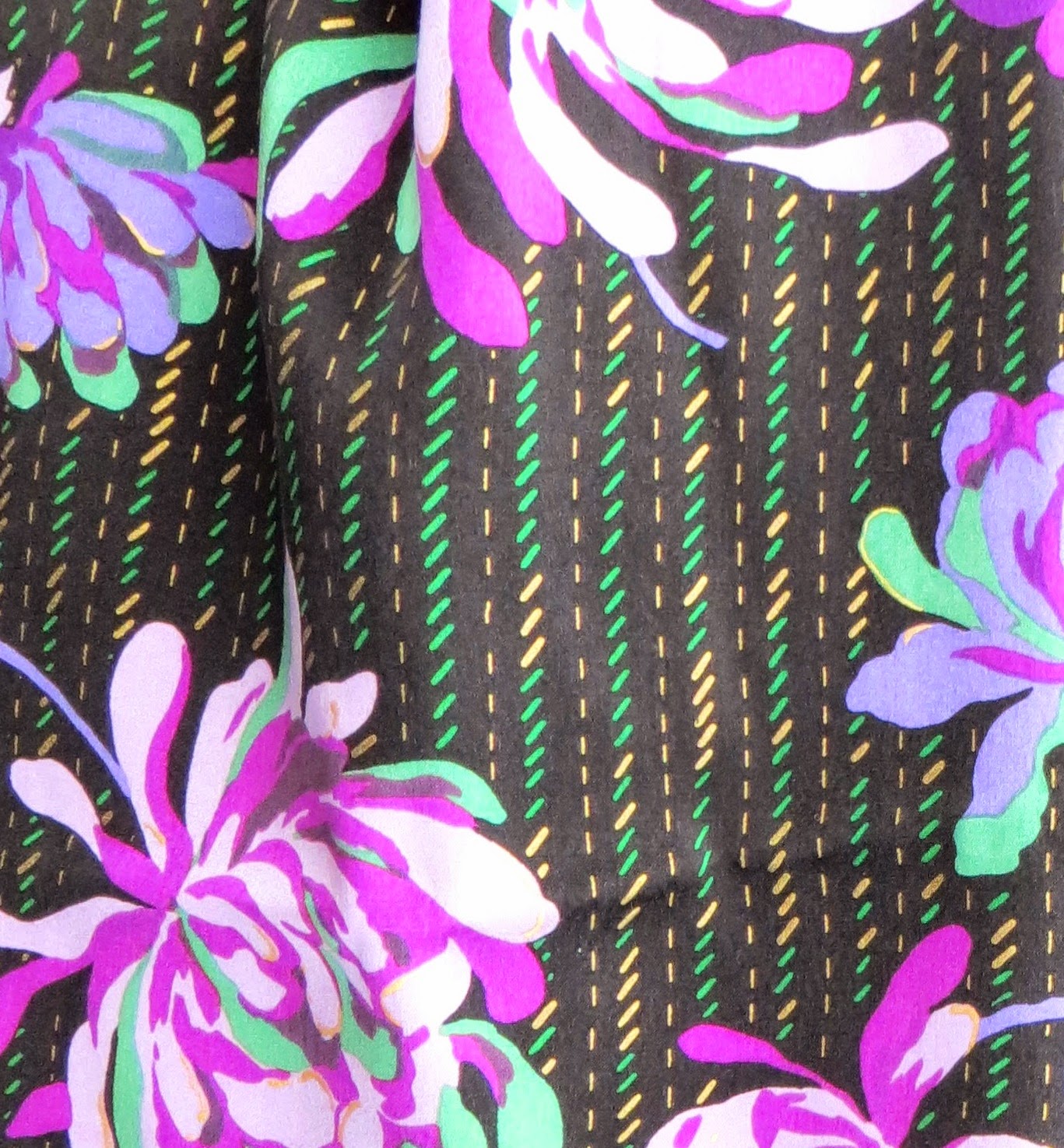
The print, as you see, has some peculiarities - I highlighted one of them with the two orange pins and the ruler. Also, there's only one flower-free border along the selvedge (shown): the chryssies are printed all the way to the selvedge on the other side.
The print has a nice small scale abstract as background. Since I'm not much of a florals type of person, I chose to highlight the flower-free edge in my blouse. Two widths of the abstract-only edge along the front, when worn under a jacket, would conceal the flowers completely.
Since the fabric demanded a pattern with a CF seam, Burda 10-2011-128, which I'd used recently to make three blouses, was an obvious choice. I'd already altered the Burda pattern at the shoulder and armscye from the dropped shoulder sleeve to a standard set in sleeve. To make this blouse a little different than the other three, I now altered the pattern further:
1. dropped the shoulder seam 4 cm towards the front
2. added two pleats to the upper front panels at the above seam
3. converted the collar ties to a stand-up collar
4. finished the front neckline with a facing
5. widened the sleeve and shortened it to bracelet length, finishing it with a 22.5 cm/9" circumference closed cuff (no buttonholes!!!)
Burda pattern at left, my alteration at right. The green lines at the front and on the collar mark use of the flower-free selvedge. At 1.5 m, there was exactly enough of that selvedge for the two front panels and the collar. The collar is a simple rectangle, folded in half lengthways.
I find it much easier to alter a successfully used pattern for small variations like these than to hunt for and test an entirely new one that's as likely as not to come with its own set of new size and fit issues.
Even though the fabric was narrow, I was able to lay out the pieces in such a way as to preserve a continuous strip along the floral selvedge. I turned that into a scarf, of course!
And here's the result: a two-tone front...
...and a very chrysanthemum back:
The stand up collar, neck opening, and the chrysanthemums give it a faintly Japanese vibe, which I like a lot.
But under a jacket, we're very serious indeed:
...where the blooms only play peekaboo:
that is, until you flash'em:
Both blouse and jacket play nicely with the matching scarf:
Styled with chunky modern silverware to reassure myself that I haven't fallen into a Victorian time warp.
Are we done yet??? It's c-c-c-cold!
A moment like this, when I get to decide on one small item to fit in with my personal style, is what makes sewing so rewarding to me.
Today I'd like to highlight what is unquestionably the oldest article of clothing I possess.
It's called a "kożuszek góralski", and is a natural sheepskin shearling short coat, decorated in the tradition of Poland's highlanders (górale), residents of Podhale, the High Tatra mountains of southern Poland. My family really loved that part of the country, and we spent many holidays there. I learned to ski in Zakopane, and hiked my little legs off around Morskie Oko, a very deep little lake whose name translates as Eye of the Sea - cue legend of a super-long underground tunnel connecting the lake to the sea - situated in one of the most picturesque valleys in the high mountains.
Here is yours truly and my beautiful young Mom, many, many years ago, at the Old Chalet in Morskie Oko. It was early spring, and all the young people staying at the chalet, my parents included, used the roof of the porch as their tanning bed, the men in nothing but their briefs (I rememer that oh so well). That hooded plaid coat that I'm wearing in the photo was made from a thick wool blanket by Mom: I get my sewing fingers honestly ;)
Look at that! I found this recent pic of the Old Chalet on the web. Amazing, eh what?! The photo of Mom and me above encompasses the porch and the left window. I have NO idea why the chalet is surrounded by this enormous madding crowd; the place was practically deserted when we were there.
Poland, by the way, has a very rich traditional ethnic dress culture. If I was to compare it to anything, I'd say the country's ethnic dress is almost as diverse and instantly informative as the tartan tradition of Scotland. However, whereas tartans are for the most part reflective of family names, the Polish folk garb reflects regional divisions. Just take a look, aren't these gorgeous? I love that the men's outfits are every bit as delightful and ornate as the ladies'.
I claim thełowicki style (second row from top, at right) by birth, and the krakowski (third row from top, centre)by descent.
But that's just the very basics; the regions have their subdivisions, and there are gazillions of wonderfully diverse variations on the main regional themes.
An aside: to fully appreciate those costumes, you really have to see them in motion. If you scroll down to the end of this post, you'll find a few links to some really dynamic, professional performances of Polish folklore.
My kożuszekdates from 1969: a gift from my mother as we were leaving for Canada (thanks, Mom!) Though not yet a teenager at the time, I stopped growing early and was almost fully grown by then, so its fit today is just about the same as when it was brand new.
In researching this subject on the internet, I was able to find just a single very tiny icon of a kożuszekthat appeared - at least at its miniscule scale, at left below - very similar to mine, at right:
I chased the link to discover that it was a "for sale" entry from five years ago, advertised as "antique, patterned on the style used for the Polish Olympic team in the 1960s". The date certainly fits! Unfortunately, the icon's link to a larger photo no longer exists, so I couldn't verify its similarity to mine in detail.
I dug around some more and discovered - aha! - that it was at the 1968 Winter Olympics in Grenoble when the Polish team's beautifully embroidered shearling coats made a fabulous impression on the world. The Poles didn't bring home a single medal from that event, but damn, they must've been a stylish looking lot. Ironically, they didn't bring their kożuszki home either, but flogged them locally for the to-them-astronomical sum of $200 (think Iron Curtain economics). Good for them, I say - free enterprise rocks.
My search for a photo or video of the team has yielded only this photo of the team's coach in a very nice shearling:
Although his coat does have traditional embroidery, the embroidery is utterly unlike mine, and with the huge hood on its back, the coat itself is very atypical. So I feel that I'm still no closer to finding out what the coats of the '68 Olympians looked like, and whether mine is at all similar to them. It would be nice to know, if only for the historical perspective.
My kożuszekis in far from perfect condition. Apart from the scuffing of its embroidery due to normal wear and tear (yes, I did wear it for the first couple of winters here, though it really isn't adequate as winter wear in Canada's severe climate), its fur has begun to separate from the leather. Limited lifetime of the tanning process, I suppose. At any rate, it's no longer wearable.
I'd like to preserve it somehow, as the original workmanship was really beautiful and it's unique. My internet search showed me that other examples from that period are practically nonexistent. There are similarly embroidered sleeveless shearling vests, serdaki (see serdak góralski), but full on long sleeved embroidered coats are rare indeed.
I'm thinking of picking or cutting the garment apart and creating a series of framed pictures of the embroidered sections.
Much of the cross stitch on the back and shoulder trim, and some of the stitching holding the leather appliqué have rubbed away so I'd have to undertake some repair work, but that strikes me as a relatively easy if painstaking task. Because the fur is falling out, it could perhaps be removed entirely (?) and replaced by facsimile trim made of faux shearling. Or I could use felt or some similar wooly cloth to allude to the original fur in a somewhat more abstract way; a slavish recreation may not be necessary.
Anyway, I'm throwing this idea out there to see if any of you might be willing to voice your opinion and give me some advice on how to proceed. It's a tricky thing - on the one hand I'd like to be respectful of the item - on the other, it offers no artistic benefit nor personal joy to me while hanging in a closet. And really, curating it in its original form is not really an option, as it has already begun to disintegrate; a process that's bound to continue.
If you got this far, here is some fab folk dancing for you that show off the folk costumes as they ought to be seen:
It starts with a song medley, but about 1m 20s into the video they begin to dance, and at 2 minutes a different set of costumes of the same region (Krakow) enters the scene.
For a unique look, not to mention pure athleticism and boy on boy competitiveness, you can't beat the dances of Podhale:
Above, the real fun begins at 2m 50s.
And finally, a dance of the central region; it begins with a very beautiful, very lyrical duet: